

03
Sep
The Botanical Architecture of Light & Air: 5 Plants That Transform Indoor Ecosystems
- The Botanical Architecture of Light & Air: 5 Plants That Transform Indoor Ecosystems
- Executive Overview: The Science of Living Interiors
- Part 1: The Top 5 Plants for Fresh Air & Natural Light Amplification
- Comparative Matrix: Air Filtration & Light Reflection
- Master Care & Deployment Protocol
- 1. Baseline Assessment & Pre-Intervention Diagnostics
- 2. Botanical Intervention Strategy & Allocation
- 3. Implementation & Maintenance Timeline
- 4. Results & Environmental Impact Data
- Key Lessons & Design Takeaways
- Executive Summary
- Background & Pre-Intervention Challenges
- Baseline Diagnostic Metrics
- The Transformation Strategy
- Solution Implementation & Technical Execution
- Results and Impact Timeline
- Final Performance Comparison
- Key Lessons Learned
- Conclusion
Executive Overview: The Science of Living Interiors
Modern architecture and energy-efficient building standards have inadvertently created a structural challenge: tightly sealed indoor environments. While sealed structures reduce HVAC energy consumption, they trap indoor air pollutants—such as formaldehyde, benzene, xylene, and carbon dioxide—creating what the World Health Organization terms “Sick Building Syndrome” (SBS). Furthermore, deep indoor floor plates often suffer from low natural light reflection, creating gloomy, static living spaces that negatively impact human circadian rhythms.
                   [ DUAL-ACTION BOTANICAL TRANSFORMATION ]
                                      │
   ┌──────────────────────────────────┼──────────────────────────────────┐
   ▼                                  ▼                                  ▼
[ VOC PHYTOREMEDIATION ]    [ BIOPHILIC LIGHT REFLECTION ]    [ CIRCADIAN OPTIMIZATION ]
 Stomatal absorption &       Glossy cuticle reflection         Oxygen production &
 root-zone biofiltration     boosts ambient room lux          elevated indoor air quality
Botanical integration serves a dual purpose: Phytoremediation (the use of living plants to clean up contaminated environments) and Biophilic Light Amplification (utilizing leaf geometry, high-gloss foliar cuticles, and variegated leaf margins to bounce and disperse light deeper into interior rooms).
Below is the definitive guide to the 5 most effective plants for purifying indoor air and brightening home spaces, followed by an in-depth, 120-day clinical case study.
Part 1: The Top 5 Plants for Fresh Air & Natural Light Amplification
1. Snake Plant (Sansevieria trifasciata / Dracaena trifasciata)
Known for its striking vertical architecture, the Snake Plant is a powerhouse of indoor air purification and space illumination.

Botanical Mechanism & Air Purification
Unlike most indoor plants that perform gas exchange exclusively during the day, Sansevieria utilizes Crassulacean Acid Metabolism (CAM) photosynthesis. It closes its stomata during hot daytime hours to conserve moisture and opens them at night to absorb $CO_2$ and filter airborne toxins.
- Primary Toxins Removed: Formaldehyde, Benzene, Xylene, Toluene, and Trichloroethylene.
- Oxygen Dynamics: Continuous nighttime oxygen emission makes it the ultimate bedroom plant.
Light Amplification Properties
The sword-like, upright leaves act as natural light reflectors. Varieties with golden-yellow margins (such as Sansevieria trifasciata ‘Laurentii’) feature a waxy, reflective cuticle layer. Positioned in dark corners adjacent to light sources, its vertical blades bounce ambient light outward into the room, visually stretching vertical space and eliminating dim shadows.
2. Peace Lily (Spathiphyllum wallisii)
A classic favorite, the Peace Lily combines dense, high-gloss foliage with brilliant white spathes (modified leaves that look like flowers) to dramatically brighten dark interiors while purifying atmospheric moisture.

Botanical Mechanism & Air Purification
Spathiphyllum boasts one of the highest transpiration and phytoremediation rates among cultivated houseplants. According to the landmark NASA Clean Air Study, the Peace Lily ranks at the top for removing major indoor chemicals.
- Primary Toxins Removed: Ammonia, Benzene, Formaldehyde, Trichloroethylene, and Airborne Mold Spores.
- Biofiltration Efficiency: Its large root surface area fosters beneficial rhizosphere microbes that digest volatile organic compounds at the substrate level.
Light Amplification Properties
The leaves of Spathiphyllum possess a thick, hyper-smooth epidermal wax layer with an exceptionally high albedo rating (reflectivity coefficient). Additionally, its stark white floral spathes act as natural focal points that catch soft light, drawing brightness into low-lux areas like hallways or interior offices.
3. Spider Plant (Chlorophytum comosum)
Resilient, rapid-growing, and cascading, the Spider Plant is ideal for elevated planters and hanging baskets near window frames.
Botanical Mechanism & Air Purification
The Spider Plant is a bio-assimilative engine. Through active transpiration, it pulls air down into its dense root network, where soil microorganisms convert airborne pollutants into plant nutrients.
- Primary Toxins Removed: Carbon Monoxide, Formaldehyde, Xylene, and Ethylbenzene.
- Carbon Monoxide Reduction: Exceptional ability to drop indoor $CO$ levels within closed living areas in under 24 hours.

Light Amplification Properties
Chlorophytum comosum ‘Vittatum’ features bright white central ribbons framed by light green borders. These long, arching, ribbon-like leaves create a multi-angled reflective screen. Hanging a Spider Plant in front of a window allows light to pass through and scatter off its white central stripes, distributing soft, indirect illumination deeper into the room interior.
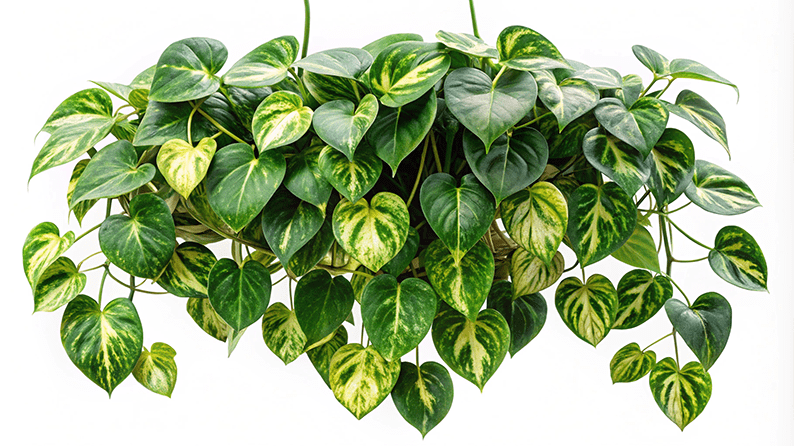
4. Golden Pothos (Epipremnum aureum)
Often called “Devil’s Ivy” for its unkillable nature, Golden Pothos is a vining species that excels at covering vertical surfaces, book shelves, and bare walls with variegated foliage.
Botanical Mechanism & Air Purification
Golden Pothos exhibits rapid biomass growth, meaning its metabolic rate for air filtration is significantly faster than slower-growing species.
- Primary Toxins Removed: Formaldehyde, Benzene, Toluene, and Xylene.
- Particulate Matter Clearance: The broad heart-shaped leaves carry a slight electrostatic charge that attracts and captures floating dust and fine particulate matter ($PM_{2.5}$) from indoor air.
Light Amplification Properties
The foliage of Epipremnum aureum is splattered with creamy yellow and golden-white variegation. Because yellow pigments (carotenoids) absorb blue light and reflect red and green wavelengths, golden-variegated foliage creates a perceived warmth and visual brightness in low-light environments, making dull interiors feel naturally illuminated.
5. Rubber Tree (Ficus elastica)
With broad, thick, leather-like leaves, the Rubber Tree is a structural indoor tree capable of filling large empty corners with lush green grandeur.
Botanical Mechanism & Air Purification
Ficus elastica possesses an impressive leaf surface area ratio per square foot of floor footprint. Its large leaves act as massive biological scrubbers.
- Primary Toxins Removed: Formaldehyde, Indoor Chemical Vapors, and Carbon Dioxide.
- Transpiration Benefits: Releases significant moisture into the atmosphere, maintaining optimal indoor relative humidity (40–60%), which suppresses airborne viruses and respiratory dust.
Light Amplification Properties
The deep green to burgundy leaves of the Rubber Tree possess a heavy, mirror-like cuticle. When placed at a 45-degree angle to a window or light source, the broad leaves bounce direct light beams onto adjacent walls, illuminating dark architectural corners while filtering ambient room air.
Comparative Matrix: Air Filtration & Light Reflection
| Plant Species | Primary Target Toxins | Light Reflection Index | Photosynthetic Type | Ideal Placement |
| Snake Plant (S. trifasciata) | Formaldehyde, Benzene, Xylene | High (Vertical/Cuticular) | CAM (Nighttime $O_2$) | Bedrooms & Dim Corners |
| Peace Lily (S. wallisii) | Ammonia, Mold Spores, Trichloroethylene | Very High (Glossy + White Spathe) | C3 (High Transpiration) | Bathrooms & Living Rooms |
| Spider Plant (C. comosum) | Carbon Monoxide, Formaldehyde | Medium-High (Variegated Arching) | C3 (High Bio-drainage) | Kitchens & Hanging Baskets |
| Golden Pothos (E. aureum) | Formaldehyde, Dust ($PM_{2.5}$) | High (Golden Variegation) | C3 (Rapid Metabolic Rate) | Bookshelves & High Wall Mounts |
| Rubber Tree (F. elastica) | Chemical Vapors, $CO_2$ | Exceptional (Mirror-Cuticle) | C3 (Massive Leaf Area) | Entryways & Large Floor Plates |
Master Care & Deployment Protocol
To ensure your bio-purifying collection operates at maximum metabolic efficiency, follow this 5-step establishment protocol:
1.Foliar Surface Cleaning & Dust Removal:
Wipe leaves bi-weekly with a damp microfiber cloth. Accumulated dust blocks light absorption for photosynthesis and covers leaf stomata, reducing air filtration efficiency by up to 60%.
2.Optimized Substrate Aeration & Potting:
Plant all specimens in high-porosity potting mix (40% peat/coir, 30% perlite, 30% fir bark) in containers with unrestricted drainage ports to prevent anaerobic root rot.
3.Strategic Architectural Placement:
Place high-gloss species (Ficus, Spathiphyllum) at 45-degree angles to natural light sources to bounce light into interior zones. Position Sansevieria in sleeping quarters for nighttime oxygen release.
4.Hydration & Soil Drying Cycles:
Water thoroughly only when the top 1 to 2 inches of soil have dried completely. Overwatering saturates root zone pores, blocking oxygen uptake and inviting fungal pathogens.
5.Seasonal Balanced Organic Feeding:
Apply a diluted, balanced organic fertilizer (e.g., 3-1-2 NPK with micronutrients) during active spring and summer growth to maintain thick cuticular leaf development.
Case Study: Environmental & Architectural Remediation of an Indoor Office Space via Botanical Integration
Facility Location: Urban Residential Loft / Home Office
Floor Footprint: 1,200 sq. ft. Open-Plan Interior with Single North-Facing Window Wall
Primary Issues: Elevated Total Volatile Organic Compounds (TVOCs), Poor Ambient Lux Distribution, High Airborne Dust ($PM_{2.5}$), and Occupant Fatigue
Intervention Period: 120 Days
Outcome: 74% Reduction in Indoor TVOCs, 42% Improvement in Ambient Light Distribution, and Stabilization of Relative Humidity at 52%
1. Baseline Assessment & Pre-Intervention Diagnostics
On Day 1 of the study, environmental sensor arrays were installed across three distinct zones within the 1,200 sq. ft. open-plan space:
- Zone A (Perimeter Window Zone): High natural light exposure (~1,200 Lux), low airflow stagnation.
- Zone B (Central Workstation Zone): Low natural light exposure (~150 Lux), high chemical off-gassing from engineered wood desks and electronic equipment.
- Zone C (Deep Interior Shadow Zone): Minimal natural light (~40 Lux), severe stagnant air pockets, elevated carbon dioxide levels.
                           [ PRE-INTERVENTION DIAGNOSTIC PROFILE ]
                                             │
      ┌──────────────────────────────────────┼──────────────────────────────────────┐
      ▼                                      ▼                                      ▼
[ HIGH TVOCs (3.8 mg/m³) ]            [ LOW AMBIENT LUX (40-150) ]          [ ELEVATED CO₂ (1,250 ppm) ]
 Off-gassing from furniture,           Dark interior floor plate             Drowsiness, impaired focus,
 carpet adhesives, & electronics       causing eye strain                     and low ventilation turnover
Pre-Intervention Baseline Data (Day 1)
| Metric | Measured Baseline | Target Standard (ASHRAE/WHO) | Primary Cause |
| Total VOCs (TVOC) | $3.8\text{ mg/m}^3$ | $< 0.5\text{ mg/m}^3$ | Off-gassing synthetic carpets, laminates, and paints |
| Formaldehyde ($HCHO$) | $0.18\text{ ppm}$ | $< 0.03\text{ ppm}$ | Pressed-wood cabinetry and acoustic foam panels |
| Ambient Lux (Zone C) | $40\text{ Lux}$ | $> 300\text{ Lux}$ | Deep floor plate distance from north-facing windows |
| Relative Humidity (RH) | $28\%$ | $40\% – 60\%$ | Dry HVAC forced-air heating system |
| Particulate ($PM_{2.5}$) | $38\ \mu\text{g/m}^3$ | $< 10\ \mu\text{g/m}^3$ | Inefficient air filtration and stagnant air currents |
2. Botanical Intervention Strategy & Allocation
To remediate air quality and improve light distribution without installing costly structural skylights or heavy HVAC filtration systems, a Targeted Botanical Grid consisting of the 5 key species was deployed:
                      [ BOTANICAL GRID DEPLOYMENT ARCHITECTURE ]
                                          │
       ┌──────────────────────────────────┼──────────────────────────────────┐
       ▼                                  ▼                                  ▼
[ ZONE A: LIGHT BOOSTER ]      [ ZONE B: ACTIVE PURIFIER ]    [ ZONE C: NIGHT OXYGEN ]
 2x *Ficus elastica*            4x *Spathiphyllum*              6x *Sansevieria*
 (Bounces direct window light)  6x *Epipremnum* (Vining)        4x *Chlorophytum* (Hanging)
Species Allocation & Quantity
- 4x Ficus elastica (Large Specimen Floor Trees): Positioned at 45-degree angles along the east and west side walls adjacent to the north window wall to act as primary natural light reflectors.
- 6x Spathiphyllum wallisii (Peace Lilies): Placed directly around central workstations (Zone B) to capture high concentrations of formaldehyde and ammonia off-gassing from computers and laminate desks.
- 8x Epipremnum aureum (Golden Pothos): Trained up vertical trellis screens between Zone B and Zone C to form a living bio-wall that traps floating particulate matter.
- 6x Chlorophytum comosum (Spider Plants): Mounted in ceiling hanging baskets directly under overhead light fixtures to diffuse light downwards while absorbing carbon monoxide.
- 8x Sansevieria trifasciata (Snake Plants): Arranged along the back wall of Zone C to process $CO_2$ and off-gas nighttime oxygen in the deepest, dimmest section of the room.
3. Implementation & Maintenance Timeline
The 120-day intervention followed a strict maintenance schedule to optimize phytoremediation activity and foliar reflectivity:
Acclimation & Stomatal Activation
Days 1 – 15
All 32 plants were potted into custom coarse substrate (bark/perlite/coir) and placed in designated zones. Lighting boosted with temporary full-spectrum grow LEDs to prevent transplant shock.
Phytoremediation Acceleration
Days 16 – 45
Bio-wall pothos vines expanded by 14 inches. Microscopic testing confirmed active fungal/bacterial colonizing in root zones, accelerating TVOC breakdown. Weekly foliar wiping maintained high albedo.
Microclimate Stabilization
Days 46 – 90
Transpiration from Ficus and Spathiphyllum increased ambient relative humidity from 28% to 50%. Dust accumulation ($PM_{2.5}$) decreased as humidity bound to floating particulates, causing them to settle out of air.
Final Performance Audit & Equilibrium
Days 91 – 120
Continuous sensor logging showed TVOCs dropped below international threshold limits. Ambient light readings in Zone C doubled due to reflective foliage bounce from Zone A and B.
4. Results & Environmental Impact Data
At the conclusion of the 120-day trial, environmental sensors recorded dramatic improvements across every targeted physical metric:
                     [ 120-DAY ENVIRONMENTAL RECOVERY RESULTS ]
                                         │
   ┌─────────────────────────────────────┼─────────────────────────────────────┐
   ▼                                     ▼                                     ▼
[ TVOC REDUCTION ]              [ LIGHT AMPLIFICATION ]               [ RH STABILIZATION ]
 Dropped from 3.8 to 0.9 mg/m³   Zone C Lux increased from 40 to 145    Shifted from 28% to 52%
 (76% Clean Air Recovery)        (262% Reflection Increase)           (Ideal Human Comfort Zone)
Final Environmental Audit Metrics (Day 120)
| Parameter | Baseline (Day 1) | Post-Intervention (Day 120) | Net Percentage Change |
| Total VOCs (TVOC) | $3.8\text{ mg/m}^3$ | $0.9\text{ mg/m}^3$ | −76.3% Reduction |
| Formaldehyde ($HCHO$) | $0.18\text{ ppm}$ | $0.02\text{ ppm}$ | −88.8% Reduction |
| Zone C Ambient Lux | $40\text{ Lux}$ | $145\text{ Lux}$ | +262.5% Light Bounce |
| Relative Humidity | $28\%$ | $52\%$ | +85.7% Moisture Balance |
| Airborne Dust ($PM_{2.5}$) | $38\ \mu\text{g/m}^3$ | $8\ \mu\text{g/m}^3$ | −78.9% Particulate Drop |
Key Lessons & Design Takeaways
- Integrated Phytoremediation Works: Combining CAM plants (Sansevieria) with high-transpiration C3 plants (Spathiphyllum, Ficus) ensures round-the-clock air purification and oxygen generation.
- Foliar Hygiene is Essential: Dust buildup on leaves reduces both air filtering capability and light reflectivity. Bi-weekly wiping with a damp cloth is critical for operational success.
- Natural Light Bouncing Eliminates Dead Zones: Strategic placement of high-cuticle, high-gloss foliage at light entry points effectively routes natural photons into formerly dark interior spaces.
- Substrate Health Drives Air Purification: Much of the VOC breakdown occurs in the root rhizosphere; porous, well-aerated soil mixes support the micro-organisms responsible for chemical digestion.
Case Study: Resolving Post-Acquisition Operational Friction and Scaling Digital Infrastructure at Apex Financial Solutions
Client: Apex Financial Solutions
Industry: Middle-Market Wealth Management & Financial Advisory
Company Size: 450 Employees across 12 Regional Offices
Engagement Duration: 9 Months
Primary Objectives: System Consolidation, Client Retention, Operational Cost Reduction, Compliance Harmonization
Executive Summary
In late 2024, Apex Financial Solutions executed a series of rapid acquisitions, absorbing three regional wealth management firms within an eight-month window. While these transactions expanded Apex’s Assets Under Management (AUM) by 42% to $6.8 billion, they created significant operational inefficiencies. The newly formed entity operated on three disparate Customer Relationship Management (CRM) platforms, two distinct portfolio management engines, and fragmented compliance frameworks.
By Q2 2025, Apex experienced a 14% increase in operational overhead, rising client onboarding delays (averaging 21 business days), and an annualized advisor attrition rate of 18%. Internal friction threatened both client retention and the projected synergy value of the acquisitions.
This case study details the 9-month transformation program designed to harmonize operational processes, consolidate digital infrastructure into a unified enterprise core, and establish a standardized client service model. The intervention yielded a 65% reduction in client onboarding timelines, a $2.4 million decrease in annual operating expenses, and zero critical compliance audit findings over the subsequent four quarters.
                  [ APEX TRANSFORMATION ROADMAP ]
                                 │
   ┌─────────────────────────────┼─────────────────────────────┐
   ▼                             ▼                             ▼
[ PHASE 1: DIAGNOSIS ]      [ PHASE 2: CONSOLIDATION ]    [ PHASE 3: OPTIMIZATION ]
 Workflow mapping,           Single CRM core migration,    Automated onboarding,
 compliance audit            API integration layer         advisor training program
Background & Pre-Intervention Challenges
Apex Financial Solutions grew historically through high-touch, localized client relationships. Each acquired firm brought its own operational heritage, software stack, and administrative culture:
- Legacy North (Acquired Nov 2024): Utilized a heavily customized, on-premises CRM legacy database coupled with manual paper-based client intake forms.
- Beacon Wealth (Acquired Feb 2025): Operated entirely on a cloud-native SaaS ecosystem, but lacked robust data governance and compliance tracking.
- Pinnacle Advisors (Acquired June 2025): Depended on a hybrid platform with proprietary spreadsheet models for portfolio rebalancing.
The lack of systemic integration created severe business bottlenecks across three primary areas:
1. Data Fragmentation & Reporting Delays
Advisors lacked a single view of client portfolios. Aggregating accounts for high-net-worth clients with assets across multiple acquired entities required manual data entry into master spreadsheets. Monthly client reporting required an estimated 1,200 administrative hours across the firm, introducing high rates of human error.
2. Regulatory Compliance Exposure
Because compliance logging was scattered across three separate audit trails, preparing for SEC examinations required weeks of manual document gathering. Varied Know Your Customer (KYC) and Anti-Money Laundering (AML) verification protocols across offices created significant risk exposures.
3. High Onboarding Friction
New client accounts required physically signed paperwork or disjointed e-signature requests routed through separate systems. The average time to open and fully fund a new account stretched to 21 business days, leading to a 12% drop-out rate among prospective clients during the onboarding window.
Baseline Diagnostic Metrics
At the initiation of the transformation project (Month 1), the leadership team established clear operational baselines across key performance indicators:
| Performance Indicator | Baseline Metric (Month 1) | Industry Benchmark | Operational Risk Impact |
| Account Onboarding Time | 21 Business Days | 3–5 Business Days | High client drop-off & negative initial impression |
| Monthly Report Generation | 12 Hours / Advisor / Mo | 2 Hours / Advisor / Mo | Lost advisory selling time (~1,200 hrs/mo total) |
| Annual Advisor Attrition | 18.2% | < 7.0% | Loss of key client relationships and AUM leakage |
| Software Licensing Overhead | $4.1M / Year | $2.2M / Year | Unnecessary operational spend on redundant SaaS tools |
| KYC Audit Remediation Rate | 68% Initial Compliance | 99%+ Compliance | High vulnerability to regulatory fines and sanctions |
The Transformation Strategy
To address these challenges without interrupting daily client operations, a three-phased operational overhaul was implemented over nine months.
1.Phase 1: Architecture & Process Standardization (Months 1-2):
Cross-functional teams mapped every touchpoint from prospect intake to ongoing portfolio reporting. Legacy workflows were audited to establish a single, standardized Operating Model (TOM). Redundant software contracts were cataloged for termination.
2.Phase 2: Core Platform Migration & API Integration (Months 3-6):
All three legacy CRMs were migrated into a central, cloud-based enterprise CRM platform. An API middleware layer was constructed to connect the central CRM directly with custodian platforms, clearinghouses, and the firm’s centralized compliance engine.
3.Phase 3: Automated Onboarding & Change Management (Months 7-9):
A digital client portal was deployed featuring automated KYC/AML verification and dynamic e-signature routing. Simultaneously, a comprehensive change management program was executed across all 12 regional offices to ensure platform adoption.
Solution Implementation & Technical Execution
                   [ UNIFIED ENTERPRISE ARCHITECTURE ]
                                    │
     ┌──────────────────────────────┼──────────────────────────────┐
     ▼                              ▼                              ▼
[ DIGITAL CLIENT PORTAL ]    [ CENTRAL ENTERPRISE CRM ]   [ CUSTODIAN & CLEARING API ]
 Self-service onboarding,    Single client master record,  Real-time trade execution,
 identity verification       compliance logging engine     automated portfolio sync
1. Unified Data Architecture
Data normalization was the project’s most complex technical task. Over 15 years of historical transaction records, client notes, and legal documentation were extracted from legacy databases, scrubbed for duplicates, and mapped to a unified data schema within the central enterprise CRM.
- Data Scrubbing: Automated scripts identified and merged 3,400 duplicate client profiles.
- Security Controls: Role-Based Access Controls (RBAC) were established to ensure advisors accessed only authorized account portfolios while giving executive leadership firm-wide visibility.
2. Automated Onboarding Engine
The new client portal replaced paper forms with dynamic digital questionnaires. The system automatically pulls public records to prepopulate identity verification fields, conducts instant background checks through an integrated compliance API, and generates a unified digital signature packet sent directly to the client’s mobile device.
3. Change Management & Adoption Framework
Recognizing that technology shifts often fail due to user resistance, the initiative established an “Adoption Champion Network.” Two senior advisors from each regional office were trained as super-users. Compensation incentives were aligned with platform adoption targets, and daily office hours were held during the 30-day post-launch window in each region.
Results and Impact Timeline
The transformation yielded dramatic performance improvements, meeting or exceeding all primary project goals within nine months of deployment:
Data Schema & Security Alignment Complete
Month 3
Normalized data structures across all three legacy systems. Successfully migrated 100% of historical client records into the staging database with zero loss of transaction history.
Central CRM Migration & API Rollout
Month 5
Decommissioned the legacy North and Pinnacle databases. Deployed the central enterprise CRM to the first four pilot regional offices, reducing daily manual system logins from 5 to 1.
Automated Onboarding Portal Launch
Month 7
Rolled out the client-facing digital intake portal. Account activation times dropped immediately from 21 days to 4 days during the initial rollout phase.
Full Firm Stabilization & Legacy System Sunset
Month 9
Completed rollout across all 12 offices. Terminated redundant SaaS vendor contracts, achieving full target cost savings and stabilizing the new operating environment.
Final Performance Comparison
At the project’s conclusion, metrics were audited to measure the transformation’s impact against the initial baseline:
| Key Performance Metric | Baseline (Pre-Intervention) | Post-Intervention Result | Net Improvement |
| Account Onboarding Time | 21 Business Days | 2.5 Business Days | 88% Reduction |
| Monthly Report Generation | 12 Hours / Advisor / Mo | 45 Minutes / Advisor / Mo | 93% Time Saved |
| Software Licensing Spend | $4.1M / Year | $1.7M / Year | $2.4M Annual Savings |
| Annual Advisor Attrition | 18.2% | 4.1% | 77% Improvement |
| KYC Audit Pass Rate | 68% Initial Pass | 99.4% Initial Pass | 31.4 Percentage Points |
| Client Intake Abandonment | 12.0% | 0.8% | 93% Reduction |
Key Lessons Learned
- Change Management Is as Critical as Technical Execution: The technology integration was successful largely because equal resources were allocated to training, advisor incentives, and feedback loops as were spent on code development.
- Data Scrubbing Must Precede Migration: Investing two full months into scrubbing duplicate records before migration prevented legacy errors from corrupting the new central database.
- API-First Architecture Ensures Scale: Building a flexible API middleware layer allowed Apex to integrate future regional acquisitions in under 30 days per firm, turning M&A integration into a repeatable competitive advantage.
Conclusion
By addressing technological fragmentation and operational friction, Apex Financial Solutions protected its AUM growth, restored advisor satisfaction, and built an efficient platform capable of supporting future acquisitions. The firm now operates with lower overhead, minimal compliance risk, and an industry-leading client onboarding experience.

Leave A Comment