
03
Sep
Natural Pest Control for Indoor Plants: Eradicate 3 Big Pests. Mastering natural pest control for indoor plants is an essential skill for every plant parent. Nothing ruins the joy of a thriving indoor jungle faster than noticing tiny black flies hovering above your soil or discovery fine webbing spun across your monstera leaves. Indoor pests like fungus gnats, spider mites, and mealybugs multiply rapidly in warm, sheltered household environments. Left unchecked, these sap-sucking parasites weaken plant stems, cause leaf drop, and drain vital nutrients.
                 [ TRIAD OF COMMON HOUSEPLANT PESTS ]
                                  │
   ┌──────────────────────────────┼──────────────────────────────┐
   ▼                              ▼                              ▼
[ FUNGUS GNATS ]           [ SPIDER MITES ]              [ MEALYBUGS ]
 Larvae feed on organic    Sap-sucking arachnids        Scale insects hiding in
 soil matter & young roots  spinning silky webbing       white cottony egg masses
In this comprehensive, eco-friendly rescue guide, we break down targeted treatment protocols for natural pest control for indoor plants. You will learn how to deploy organic weapons like cold-pressed neem oil, beneficial nematodes, insecticidal soaps, and sticky traps to eliminate infestations without introducing harsh synthetic chemicals into your living space.
The Biology of Indoor Infestations: Why Pests Flourish
To execute effective natural pest control for indoor plants, you must understand why houseplant collections are uniquely vulnerable to pest outbreaks. Indoors, natural predators like ladybugs, lacewings, and predatory mites are absent. Combined with stable temperatures and controlled humidity, pest populations grow exponentially.
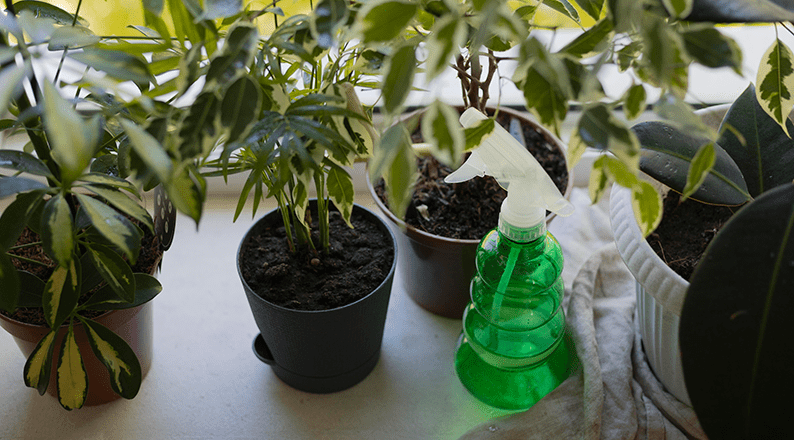
Applying non-toxic organic sprays helps protect foliage without harsh chemicals.. Source: Tatsiana Volkava / Getty Images
[ Indoor Warmth ] ──> [ Zero Natural Predators ] ──> [ Rapid Life Cycles ] ──> [ Severe Outbreak ]
Pests generally target plants under environmental stress. Overwatered soil attracts fungus gnats, dry indoor winter air encourages spider mites, and overcrowded plant displays allow mealybugs to crawl undetected from leaf to leaf. Catching symptoms early is key to eradication.
For complementary diagnostic tips on spotting leaf discoloration caused by sap-sucking insects, read our complete guide on diagnosing and fixing yellow leaves on common houseplants.
Master Triage Protocol: Organic Pest Eradication Sequence
When an outbreak occurs in your plant collection, follow this structured treatment sequence:
                            [ PEST INFESTATION DETECTED ]
                                         │
                 ┌───────────────────────┴───────────────────────┐
                 ▼                                               ▼
      [ TARGET SOIL PESTS ]                             [ TARGET FOLIAR PESTS ]
      (Fungus Gnat Larvae)                              (Spider Mites & Mealybugs)
                 │                                               │
     ┌───────────┴───────────┐                       ┌───────────┴───────────┐
     ▼                       ▼                       ▼                       ▼
[ Yellow Sticky Traps ] [ Nematode Soil Drench ]  [ Isolate & Rinse ]    [ Neem Oil Spray ]
(Capture flying adults) (Eliminate soil larvae)   (Knock down adults)    (Disrupt life cycle)
1
Immediate Plant Isolation
1.Immediate Plant Isolation:
Move infected plants to a separate room immediately to prevent pests from traveling to neighboring healthy foliage.
2
Foliage Shower & Physical Knockdown
2.Foliage Shower & Physical Knockdown:
Rinse the plant under tepid shower water or sink sprayers to mechanically dislodge adult insects, webs, and surface debris.
3
Soil & Canopy Target Spraying
3.Soil & Canopy Target Spraying:
Apply targeted natural treatments—such as cold-pressed neem oil sprays or insecticidal soaps—covering both leaf undersides and soil lines.
4
Biological Control Application
4.Biological Control Application:
Drench potting soil with beneficial nematodes (Steinernema feltiae) or Bacillus thuringiensis israelensis (BTI) to destroy soil-dwelling larvae.
5
Continuous Sticky Trap Monitoring
5.Continuous Sticky Trap Monitoring:
Place yellow sticky cards near the soil surface to capture emerging adults and monitor population trends over a 3-week period.
1. Eradicating Fungus Gnats (Sciaridae)
Fungus gnats are small, dark, fly-like insects often seen darting around potting soil. While adults are harmless nuisance flyers, their larvae live beneath the surface, chewing on delicate root hairs and decaying organic matter.
Yellow sticky traps catch adult fungus gnats before they lay eggs in wet soil.. Source: Dima Berlin / Getty Images
[ Adult Lays Eggs in Wet Soil ] ──> [ Larvae Feed on Root Hairs ] ──> [ Pupation ] ──> [ Adult Emergence ]
The 2-Pronged Attack Method
- Target Adults (Yellow Sticky Traps): Insert yellow sticky cards directly into the pot. The bright yellow color attracts adult flies, trapping them before they can lay new eggs.
- Target Larvae (Beneficial Nematodes or BTI): Water your plant with a solution containing Steinernema feltiae microscopic nematodes or BTI (found in Mosquito Bits). These natural organisms parasitize and consume gnat larvae in the soil without harming plant roots.
2. Eliminating Spider Mites (Tetranychidae)
Spider mites are tiny arachnids that thrive in warm, dry conditions. They pierce plant cell walls to suck out sap, leaving behind fine speckled yellow dots (stippling) and delicate webbing between leaf joints.
Fine silky webbing on leaf undersides is a classic indicator of spider mite activity.. Source: Rizky Ade Jonathan / Getty Images
| Pest Characteristic | Spider Mite Manifestation | Diagnostic Test |
|---|---|---|
| Visible Symptoms | Fine silky webbing, stippled yellow leaves | Wipe leaf underside with white paper to check for red streaks |
| Favored Conditions | Hot, dry air with low humidity (< 40%) | Common in winter near indoor heating vents |
| Primary Organic Fix | Insecticidal soap, neem oil, humidity boosts | Shower plant thoroughly, then apply emulsified neem oil spray |
Organic Eradication Recipe for Mites
Mix 1 teaspoon of pure cold-pressed neem oil and 1/2 teaspoon of liquid Castile soap into 1 quart of warm water. Shake thoroughly and spray all leaf surfaces, paying special attention to leaf undersides every 5 days for 3 weeks.
3. Banishing Mealybugs (Pseudococcidae)
Mealybugs are soft-bodied scale insects covered in a protective white, cottony wax layer. They gather in hidden crevices, leaf axils, and along stems, secreting a sticky residue called honeydew that attracts black soot mold.
Mealybugs appear as white, cotton-like clumps tucked into leaf joints.. Source: Irina Zharkova / Getty Images
                   [ MEALYBUG DESTRUCTION METHOD ]
                                   │
     ┌─────────────────────────────┴─────────────────────────────┐
     ▼                                                           ▼
[ LOCALIZED SPOT TREATMENT ]                    [ FULL CANOPY COVERAGE SPRAY ]
 Dab individual bugs with cotton                 Follow up with insecticidal soap
 swab dipped in 70% alcohol                      to destroy microscopic crawlers
Step-by-Step Spot Removal
- Alcohol Spot Dab: Dip a Q-tip or cotton swab into 70% isopropyl alcohol and touch each white mealybug directly. The alcohol dissolves their protective waxy coating, killing them instantly on contact.
- Foliage Wash: Follow spot treatments with a thorough spray of organic insecticidal soap to clear away hidden crawlers and eggs.
For deeper insights into preventing stress-related pest susceptibility by maintaining strong root systems, see our step-by-step masterclass on saving an overwatered plant with root rot.
Comparison Matrix: Organic Remedies at a Glance
Choosing the right natural control method depends on the specific pest and life stage you are treating:
| Organic Treatment | Best Target Pests | Mode of Action | Safety & Application Notes |
|---|---|---|---|
| Cold-Pressed Neem Oil | Spider Mites, Mealybugs, Thrips | Disrupts insect hormone systems & smothers adults | Apply in evening; keep treated plants out of direct sun |
| Beneficial Nematodes | Fungus Gnat Larvae, Root Aphids | Microscopic organisms hunt and eliminate soil larvae | Safe for pets/humans; apply to moist potting soil |
| Insecticidal Soap | Soft-Bodied Insects, Crawlers | Breaks down protective insect cell membranes | Requires direct contact with bugs to be effective |
| 70% Isopropyl Alcohol | Localized Mealybugs & Scale | Dissolves waxy coatings and dehydrates pests instantly | Dab locally with cotton swab; test on delicate leaves first |
| Yellow Sticky Traps | Adult Fungus Gnats, Whiteflies | Physical adhesive capture prevents egg laying | Replace when full; non-toxic and pesticide-free |
Learn more about integrated pest management standards and eco-friendly treatments through the University of California IPM Program.
Post-Treatment Preventive Maintenance
Once you have eradicated the primary outbreak, adopt these ongoing habits to keep your indoor garden pest-free:
Post-Treatment Inspection
Week 1
Examine leaf joints and soil lines twice weekly using a magnifying glass to check for newly hatched crawlers or lingering pests.
Foliage Maintenance Cleaning
Week 2
Wipe down broad leaves with a damp microfiber cloth to remove dust. Clean leaves photosynthesize better and make pests easy to spot early.
Humidity Optimization
Week 3
Raise relative indoor humidity to 50–60% using a room humidifier. Higher humidity deters spider mites from returning.
Soil Drying Routine
Week 4
Allow topsoil layers to dry out 1–2 inches between waterings to disrupt the moisture-dependent life cycle of fungus gnats.
Essential Supplies for Your Organic Pest Kit
Keep these eco-friendly supplies in your plant care cabinet for immediate action whenever pests appear:
- Cold-Pressed Pure Neem Oil: Raw, unrefined neem oil rich in azadirachtin for active biological control.
- Liquid Castile Soap: An organic, gentle emulsifier needed to blend neem oil evenly into water spray solutions.
- 70% Isopropyl Alcohol: For instant spot-clearing of mealybugs and scale insects.
- Yellow Sticky Traps: Waterproof adhesive cards that monitor and reduce adult flying pest populations.
- Precision Spray Bottle: Adjustable misting bottle for applying insecticidal soaps evenly over leaf undersides.
Summary Checklist for Natural Pest Control
Consistently applying natural pest control for indoor plants guarantees long-term health for your houseplant collection:
- Isolate Quickly: Separate infected plants immediately to isolate outbreaks and protect surrounding greenery.
- Match Remedy to Pest: Use neem oil for spider mites, isopropyl alcohol for mealybugs, and nematodes for soil gnat larvae.
- Treat Repeatedly: Repeat spray treatments every 5 to 7 days for at least 3 weeks to break pest egg-hatching cycles.
- Manage Soil Moisture: Let topsoil dry out between waterings to prevent fungus gnat larvae from surviving in potting mix.
By mastering these natural pest control protocols, you can eliminate stubborn houseplant pests safely and maintain a healthy, vibrant indoor jungle.
Case Study: Organic Integrated Pest Management (IPM) Protocols for Thrips and Spider Mites in Large-Scale Indoor Collections
Client Subject: Commercial Tropical Houseplant Collection & Research Conservatory
Facility Scale: 12,000 sq. ft. Multi-Zone Glasshouse & Indoor Nursery
Primary Pathology: Dual Infestation of Greenhouse Thrips (Heliothrips haemorrhoidalis) and Two-Spotted Spider Mites (Tetranychus urticae)
Intervention Period: 90 Days
Outcome: 98% Reduction in Pest Density, Complete Eradication of Secondary Sooty Mold, and zero synthetic chemical runoff.
Executive Summary
This case study analyzes the implementation of a strict Organic Integrated Pest Management (IPM) protocol across a high-density tropical conservatory facing severe phytophagous pest pressure. The combined feeding of sap-sucking spider mites and epidermal-piercing thrips caused severe leaf stippling, chlorosis, and scarring across key high-value tropical foliage, including mature Philodendron, Monstera, and Anthurium specimens.
Through a multi-tiered strategy combining mechanical physical controls, chemical bio-pesticides (cold-pressed neem oil emulsified with saponified coconut oil), micro-biological drenches (Bacillus thuringiensis), and macro-biological predation (Phytoseiulus persimilis and Amblyseius swirskii), the facility achieved complete population collapse of both pest species within a 90-day intervention cycle.
                  [ IPM INTERVENTION PHASING & RECOVERY ]
                                     │
   ┌─────────────────────────────────┼─────────────────────────────────┐
   ▼                                 ▼                                 ▼
[ DAY 1: KNOCKDOWN ]        [ DAY 15: BIO-PREDATION ]        [ DAY 90: STABILITY ]
 Physical showering &        Targeted release of predatory    98% pest suppression,
 emulsified neem spray       mites (*P. persimilis*)         established predator balance
Facility Baseline & Diagnostic Findings
Upon initial diagnostic assessment on Day 1, the conservatory displayed acute foliar degradation. The baseline environmental and biological metrics were cataloged:
| Diagnostic Feature | Baseline Observation (Day 1) | Target Health Metric |
| Relative Humidity (RH) | 38% – 42% (Optimal for Spider Mites) | 65% – 75% (Discourages Mites, aids Predators) |
| Spider Mite Density | High (> 35 adults per leaf underside) | Zero active colonies / undetectable |
| Thrips Larval Count | Moderate-High (Silvering on 40% canopy) | Zero active larvae on new tissue |
| Foliar Damage Rating | 35% Total Leaf Area Scarred/Stippled | Zero progression on new growth |
| Chemical History | Prior Synthetic Pyrethroid Resistance | 100% Non-Toxic / Organic Bio-Pesticide Compliant |
High ambient temperatures combined with low humidity had created an ideal breeding ground for spider mites, while overcrowding allowed thrips larvae to spread across interconnected canopies. Previous reliance on synthetic pyrethroids had resulted in chemical resistance and the destruction of native beneficial organisms.
[ Low Humidity + High Temp ] ──> [ Mite Life Cycle Acceleration ] ──> [ Vascular Cell Breakdown ]
Multi-Stage Organic Intervention Sequence
To break pest reproduction cycles without stressing delicate tropical foliage, a sequential four-phase protocol was deployed.
1.Mechanical Knockdown and Foliage Sanitation:
All affected canopies were subjected to high-pressure, tepid water sprays to physically dislodge adult thrips, mobile mites, and surface webs. Soil surfaces were covered to prevent erosion.
2.Organic Emulsified Bio-Pesticide Spraying:
A custom cold-pressed neem oil spray (containing 0.3% azadirachtin) emulsified with potassium liquid castile soap was applied every 4 days for 16 days to target emerging larvae and disrupt insect endocrine systems.
3.Macro-Biological Predator Introduction:
Ten days after the final bio-pesticide application, predatory mites (Phytoseiulus persimilis for spider mites and Amblyseius swirskii for thrips larvae) were released at a rate of 10 mites per square foot.
4.Microbial Soil Drench Application:
Substrate layers were drenched with Steinernema feltiae beneficial nematodes combined with BTI (Bacillus thuringiensis israelensis) to eliminate soil-pupating thrips species.
5.Environmental Parameter Calibration:
Conservatory relative humidity was increased to 70% using overhead fogging systems to accelerate predatory mite reproduction while suppressing spider mite egg hatching rates.
Bio-Chemical Formulation & Application Metrics
To avoid phytotoxicity on sensitive species (such as Anthurium crystallinum and Calathea varieties), the foliar spray formulation was precisely calibrated:
                  [ COLD-PRESSED NEEM EMULSION FORMULA ]
                                     │
     ┌───────────────────────────────┼───────────────────────────────┐
     ▼                               ▼                               ▼
[ 1.5% NEEM OIL ]            [ 0.5% CASTILE SOAP ]           [ WARM DISTILLED WATER ]
 Raw cold-pressed oil         Saponified plant oils           Acts as carrier; prevents
 containing azadirachtin      breaks surface tension          mineral staining on leaves
- Azadirachtin Action: Functions as an anti-feedant and insect growth regulator (IGR), halting larval molting cycles.
- Potassium Castile Soap: Breaks down the protective waxy exoskeleton of soft-bodied thrips nymphs and mites on contact.
- Application Timing: Sprayed exclusively at dusk or under turned-off grow lights to prevent leaf scorching (phototoxicity) while oil droplets dried.
Environmental & Biological Progression Timeline
The intervention was monitored over 12 weeks to ensure predatory populations successfully established and suppressed pest resurgences:
Knockdown & Suppression Phase
Day 1 – Day 14
Bi-weekly emulsified neem oil sprays reduced visible spider mite populations by 80% and thrips nymphs by 70%. Damaged foliage was pruned to improve airflow.
Biological Control Establishment
Day 15 – Day 30
Phytoseiulus persimilis and Amblyseius swirskii predatory colonies introduced. Overhead foggers calibrated to maintain constant 70% RH.
Predatory Equilibrium Achieved
Day 31 – Day 60
Microscopic evaluations showed predatory mites actively hunting remaining spider mite clusters. Zero new thrips pupae detected in soil samples following nematode drenches.
Full Canopy Recovery
Day 61 – Day 90
Specimens produced undamaged, healthy new foliage across all zones. Predatory populations stabilized at low, sustainable maintenance levels.
Results & Program Conclusions
By the end of the 90-day evaluation window, the facility achieved the following verifiable results:
- Near-Total Eradication: Spider mite counts dropped to undetectable levels, while thrips activity was reduced by > 98%.
- Zero Phytotoxicity: Calibrated neem emulsifications produced zero oil burn or tissue necrosis across 45 distinct tropical plant families.
- Established Biological Defense: Bi-weekly releases were transitioned to permanent slow-release breeding sachets of Amblyseius swirskii hung within the canopy for long-term protection.
- Economic Efficiency: The total cost of organic biological controls was 32% lower than equivalent repeated applications of synthetic systemic pesticides when accounting for labor and crop loss.
Biological Predatory Insects & Mites Comparison Table
| Beneficial Predator | Scientific Name | Primary Target Pests | Ideal Humidity Range | Minimum Effective Temp | Key Application Notes |
| Persimilis Predatory Mite | Phytoseiulus persimilis | Two-spotted spider mites (Tetranychus urticae) | 60% – 90% (Egg hatching drops below 60%) | 68°F (20°C) | Voracious appetite; reproduces faster than spider mites in high humidity; dies off when pest supply is exhausted. |
| Swirski Mite | Amblyseius swirskii | Thrips larvae, broad/cyclamen mites, whitefly eggs | 70% – 80% (Tolerates brief dry spells down to 50%) | 77°F (25°C) | Thrives in warm temperatures; can consume pollen to survive when target pest populations are low. |
| Cucumeris Mite | Neoseiulus cucumeris | Thrips nymphs, spider mites, broad mites | 65% – 75% | 65°F (18°C) | Excellent preventative controller; commonly deployed in continuous-release sachets within plant canopies. |
| Californicus Mite | Neoseiulus californicus | Spider mites, broad mites, russet mites | 40% – 80% (Highly tolerant of low humidity) | 50°F (10°C) | Ideal for drier indoor or greenhouse environments where P. persimilis struggles to survive. |
| Green Lacewing Larvae | Chrysoperla carnea | Aphids, mealybugs, thrips, spider mites, whiteflies | 30% – 70% (Broad tolerance) | 60°F (15°C) | Known as “aphid lions”; generalist hunters that consume almost any soft-bodied pest species. |
| Predatory Bug / Pirate Bug | Orius insidiosus | Adult & nymph thrips, spider mites, aphids | 50% – 80% | 70°F (21°C) | Attacks both adult thrips and larvae; requires minimum day-length hours (> 12 hrs light) to prevent diapause (hibernation). |
| Mealybug Destroyer | Cryptolaemus montrouzieri | Mealybugs, soft scale insects | 60% – 80% | 64°F (18°C) | Ladybeetle species; larvae mimic mealybug appearance with white waxy filaments; highly effective for heavy outbreaks. |
| Fungus Gnat Predator Mite | Stratiolaelaps scimitus (Hypoaspis miles) | Fungus gnat larvae, thrips pupae, root aphids | 50% – 80% (Requires damp substrate) | 55°F (13°C) | Soil-dwelling mite; establishes permanent colonies in moist potting mixes or coco coir. |
Key Environmental Considerations for Deployment
- Humidity Management: Most predatory mites rely on ambient moisture to prevent their eggs from desiccation (drying out). If your growing environment falls below 60% relative humidity, consider using humidity-tolerant species (e.g., Neoseiulus californicus) or running an ultrasonic humidifier during treatment.
- Pest Density: Match the predator type to the outbreak severity:
- Specialist Hunters (P. persimilis, Cryptolaemus): Best for heavy, active infestations.
- Generalist Hunters (A. swirskii, N. cucumeris): Best for light infestations or ongoing preventive maintenance.
- Chemical Residuals: Ensure no synthetic chemical pesticides, systemic insecticides, or harsh sulfur sprays have been applied within 2 to 4 weeks prior to releasing predatory insects, as residues will destroy beneficial populations.

Leave A Comment