
03
Sep
- The Beginner’s Guide to Raising a Healthy Indoor Citrus Tree
- The Physiology of Indoor Citrus: Why Potted Trees Struggle
- Master Setup Sequence for Indoor Citrus Success
- 1. High-Intensity Lighting: Meeting Citrus Energy Needs
- 2. Hand-Pollination Techniques for Fruit Set
- 3. Specialized Acidic Feeding & Soil pH Management
- Seasonal Care Matrix: Indoor vs. Outdoor Care
- Post-Transition Care: What to Expect Year-Round
- Essential Supplies for Your Indoor Citrus Kit
- Summary Checklist for Healthy Indoor Citrus
- Case Study: Commercial Production Scale-Up and Environmental Acclimation of Citrus × meyeri (Dwarf Meyer Lemon) in Closed-Loop Indoor Facilities
- Executive Summary
- Background & Initial Diagnostic Findings
- Multi-Phase Corrective Protocol
- Environmental & Fertigation Engineering
- Crop Recovery Progress & Results Timeline
- Operational Lessons & Protocols for Indoor Citrus
The Beginner’s Guide to Raising a Healthy Indoor Citrus Tree
Mastering raising a healthy indoor citrus tree is one of the most rewarding milestones for any houseplant enthusiast. Few indoor plants offer the sensory delights of dwarf Meyer lemons, key limes, or calamondin oranges—filling your home with fragrant white blossoms before bearing sweet, sun-kissed fruit. However, transitioning a sun-loving Mediterranean tree indoors presents unique challenges. Without proper care, indoor citrus trees frequently shed leaves, drop flower buds, and fail to set fruit.
                 [ TRIAD OF INDOOR CITRUS CHALLENGES ]
                                  │
   ┌──────────────────────────────┼──────────────────────────────┐
   ▼                              ▼                              ▼
[ INSUFFICIENT LIGHT ]      [ NO NATURAL POLLINATORS ]    [ ALKALINE/NUTRIENT LOCKOUT ]
 Leaves drop & photosynthesis  Flowers fall off unpollinated  Iron chlorosis causes yellow
 stalls without 8+ hrs light   without human intervention     foliage in high-pH soil
In this comprehensive educational guide, we break down essential care protocols for raising a healthy indoor citrus tree. You will learn how to set up high-intensity supplemental lighting, master manual hand-pollination, and supply specialized acidic nutrition to keep your potted citrus thriving year-round.
The Physiology of Indoor Citrus: Why Potted Trees Struggle
To succeed at raising a healthy indoor citrus tree, you must understand how indoor environments differ from natural orchard habitats. Citrus trees are heavy feeders with high metabolic rates, requiring continuous sunlight, warm temperatures, and acidic soil to absorb micronutrients like iron, zinc, and manganese.
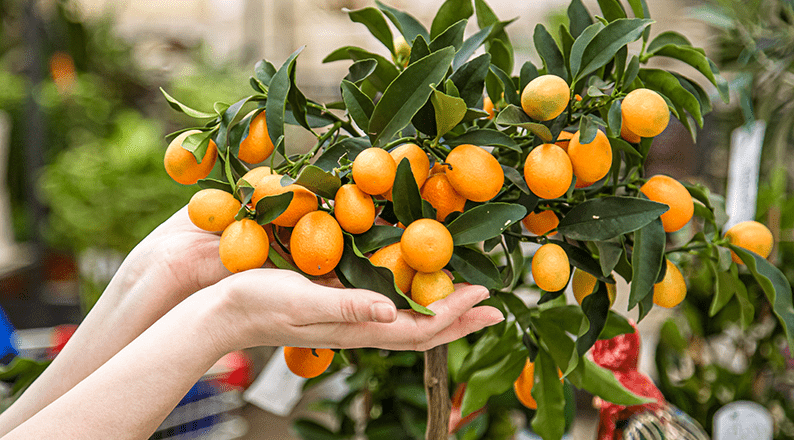
Dwarf citrus trees like Meyer lemons thrive indoors when provided with ample light and acidic nutrients.. Source: Olga Yastremska / Getty Images
[ Low Indoor Lux ] ──> [ Reduced Sugar Production ] ──> [ Blossom Abscission ] ──> [ Total Leaf Drop ]
When moved indoors for autumn and winter, trees encounter dry heated air, reduced window light, and stagnant room conditions. In response, a citrus tree sheds leaves to reduce water demand. Furthermore, because indoor living rooms lack outdoor wind and pollinating insects, blossoms simply dry up and drop off without ever setting fruit.
For diagnostic insights on identifying leaf chlorosis caused by root stress before indoor leaf drop occurs, consult our masterclass on diagnosing and fixing yellow leaves on common houseplants.
Master Setup Sequence for Indoor Citrus Success
Follow this step-by-step framework to establish ideal growing conditions indoors:
                            [ INDOOR CITRUS CARE PROTOCOL ]
                                          │
                  ┌───────────────────────┴───────────────────────┐
                  ▼                                               ▼
       [ LIGHT & ENVIRONMENT ]                           [ NUTRITION & FRUITING ]
       (High Lux Setup)                                  (pH & Pollination)
                  │                                               │
      ┌───────────┴───────────┐                       ┌───────────┴───────────┐
      ▼                       ▼                       ▼                       ▼
[ Full-Spectrum LED ]   [ Air Circulation ]     [ Acidic Fertilizer ]   [ Hand Pollination ]
(12-16 hrs daily)       (Avoid heat vents)      (Maintain pH 5.5-6.5)   (Brush flower centers)
1
Location and Full-Spectrum Light Installation
1.Location and Full-Spectrum Light Installation:
Position your tree near an unobstructed south-facing window. Supplement natural sunlight with a 30W–50W full-spectrum LED grow light placed 12–18 inches above the canopy for 12 to 16 hours daily.
2
Soil Aeration and Drainage Check
2.Soil Aeration and Drainage Check:
Pot your citrus in a well-draining, lightweight mix amended with pine bark and perlite. Ensure the pot features ample bottom drainage holes to prevent root saturation.
3
Acidic Micronutrient Feeding Schedule
3.Acidic Micronutrient Feeding Schedule:
Apply a specialized citrus fertilizer formulated with an NPK ratio around 2-1-1 or 3-1-2, rich in chelated iron and sulfur to maintain soil pH between 5.5 and 6.5.
4
Manual Hand-Pollination Protocol
4.Manual Hand-Pollination Protocol:
As fragrant white flowers open, use a soft artist’s paintbrush or cotton swab to transfer yellow pollen from male anthers to the central female stigma on every bloom.
5
Humidity and Temperature Balancing
5.Humidity and Temperature Balancing:
Keep trees away from heating vents and drafty exterior doors. Group plants together over pebble trays or run a humidifier to maintain relative humidity above 50%.
1. High-Intensity Lighting: Meeting Citrus Energy Needs
Citrus trees require at least 8 hours of direct, intense sunlight daily just to maintain foliage, and 12+ hours to develop fruit. Standard indoor windows rarely provide enough light, especially during short winter days.
       [ SUNLIGHT REQUIREMENT ]  ──> 8–12 Hours Direct Light (50,000 Lux Outdoor Benchmark)
       [ INDOOR WINDOW ONLY ]     ──> 2,000–5,000 Lux (Triggers leaf drop & fruit abortion)
       [ SUPPLEMENTAL LED SETUP ] ──> 15,000–25,000 Lux at Canopy Level (Optimal Indoor)
Grow Light Recommendations
- Light Type: Full-spectrum LED grow light bulbs or panel arrays emitting light across both blue (vegetative support) and red (flowering and fruiting) wavelengths.
- Duration: Run lighting on an automatic timer set for 12 to 16 hours continuous illumination daily.
- Distance: Mount lights 12 to 18 inches above the top leaves, adjusting height as the canopy grows to prevent light scorch.
2. Hand-Pollination Techniques for Fruit Set
Outdoors, bees and wind carry pollen from flower to flower. Indoors, raising a healthy indoor citrus tree that bears fruit requires manual hand-pollination. Citrus flowers are self-fertile, meaning a single bloom contains both male and female reproductive organs.
Gently brushing pollen from the outer anthers onto the central stigma ensures fruit set.. Source: Sebastian Frank / Getty Images
[ Yellow Outer Anthers (Pollen) ] ──(Soft Paintbrush Transfer)──> [ Center Sticky Stigma (Receiver) ]
Step-by-Step Hand-Pollination
- Identify the Flower Parts: Look inside a freshly opened white blossom. The ring of yellow, powder-covered stalks on the outside are the anthers (male). The raised, sticky green cylinder in the center is the stigma (female).
- Collect and Transfer Pollen: Swirl a small, dry, soft-bristled paintbrush or cotton swab gently over the yellow anthers to collect pollen grains.
- Dab the Stigma: Touch the pollen-coated brush directly onto the sticky tip of the central stigma.
- Repeat Daily: Pollinate newly opened blossoms every afternoon while flowers remain open. Successfully pollinated flowers will drop their white petals, revealing a tiny green embryonic fruit at the center.
3. Specialized Acidic Feeding & Soil pH Management
Citrus trees are acid-loving plants that require a soil pH range between 5.5 and 6.5. In alkaline soils (pH > 7.0), essential micronutrients—especially iron, zinc, and manganese—become chemically bound to soil particles, preventing roots from absorbing them even if present in the substrate.
Acidic soil and iron supplementation prevent leaf chlorosis and support heavy fruit loads.. Source: faithiecannoise / Getty Images
| Nutrient / Metric | Ideal Range / Ratio | Biological Function | Deficiency Symptoms |
|---|---|---|---|
| Soil pH | 5.5 – 6.5 (Slightly Acidic) | Enables micronutrient solubility | Interveinal chlorosis (yellow leaves with green veins) |
| NPK Ratio | 2-1-1 or 3-1-2 (High Nitrogen) | Supports vigorous leafy shoot growth | Overall pale green leaves, stunted growth |
| Chelated Iron (Fe) | Added in spring & summer | Essential for chlorophyll synthesis | Youngest leaves turn bright yellow |
| Magnesium (Mg) | Add Epsom salts (MgSO4) if low | Core component of chlorophyll molecule | Yellowing along outer leaf margins in inverted V-shape |
Fertilizer Application Protocol
- Spring and Summer (Active Growth): Feed every 2 to 3 weeks using an organic liquid citrus fertilizer or sulfur-amended acidic plant food.
- Autumn and Winter (Resting Period): Reduce feeding frequency to once every 6 to 8 weeks, using half-strength formulations to prevent fertilizer salt burn.
For guidance on managing soil drainage and rescuing trees suffering from soggy potting mix, review our step-by-step masterclass on saving an overwatered plant with root rot.
Seasonal Care Matrix: Indoor vs. Outdoor Care
If you live in a region with cold winters, move your citrus tree outdoors during warm summer months to boost vigor, then transition it indoors before night temperatures drop below 50°F (10°C).
| Parameter | Summer Outdoor Phase | Winter Indoor Phase |
|---|---|---|
| Light Source | Direct unfiltered sunlight (8+ hours) | South window + full-spectrum LED grow light |
| Watering Needs | Deeply 2–3 times per week as topsoil dries | Sparingly; allow top 2 inches of soil to dry out |
| Relative Humidity | Ambient outdoor levels (typically > 50%) | Group with plants, use pebble trays, run humidifier |
| Pollination | Natural wind, bees, and hoverflies | Manual hand-pollination with a soft brush |
| Fertilizer Needs | Full-strength acidic citrus food bi-weekly | Half-strength feeding every 6–8 weeks |
Learn more about citrus cultivation and disease management standards from the University of California IPM Citrus Guide.
Post-Transition Care: What to Expect Year-Round
Caring for an indoor citrus tree follows a distinct seasonal cycle. Use this timeline to anticipate plant needs:
Blossom Burst & Hand Pollination
Early Spring
Fragrant blooms cover the branches. Increase watering frequency, begin bi-weekly acidic feeding, and hand-pollinate blooms daily.
Fruit Set & Outdoor Transition
Late Spring / Summer
Tiny green citrus fruits form. Acclimate the tree to outdoor morning sun over 7 to 10 days before placing it in full outdoor sunlight for summer.
Indoor Acclimation & Pest Check
Early Autumn
Move the tree back indoors before ambient night temperatures drop below 50°F (10°C). Treat foliage with neem oil spray to clear outdoor pests like spider mites.
Fruit Ripening & Maintenance
Winter
Fruit expands and ripens from green to bright yellow/orange. Run full-spectrum grow lights 14 hours daily and monitor soil moisture carefully.
Essential Supplies for Your Indoor Citrus Kit
Keep these specialized tools ready to ensure long-term success with indoor citrus trees:
- Full-Spectrum 30W+ LED Grow Light: Provides essential light wavelengths needed for photosynthesis and fruit development indoors.
- Acidic Citrus Fertilizer (with Micronutrients): Delivers nitrogen, phosphorus, potassium, and chelated iron formulated for acid-loving trees.
- Fine-Tip Artist’s Paintbrush: A soft tool used to manually transfer pollen between blooms.
- Soil pH & Moisture Meter: Monitors substrate acidity (pH 5.5–6.5 target) and checks root-zone moisture levels before watering.
- Cold-Pressed Neem Oil Spray: An organic treatment that protects indoor citrus from scale insects, spider mites, and mealybugs.
Summary Checklist for Healthy Indoor Citrus
Successfully raising a healthy indoor citrus tree relies on delivering consistent environmental conditions and proper nutrition:
- Maximize Light: Combine bright window light with full-spectrum LED grow lights for 12 to 16 hours daily to prevent winter leaf drop.
- Pollinate Manually: Use a soft brush to transfer pollen from male anthers to female stigmas to set fruit indoors.
- Maintain Acidic pH: Use citrus-specific fertilizer to keep soil pH between 5.5 and 6.5, ensuring iron and micronutrient absorption.
- Water Wisely: Allow the top 2 inches of soil to dry out between waterings, and ensure containers feature unrestricted drainage.
By following these targeted care protocols, you can enjoy lush green foliage, fragrant white blossoms, and home-grown citrus fruit right inside your home.
The 4 Most Popular Indoor Citrus Varieties
| Variety | Fruit Features | Flavor Profile | Growth & Ease |
| Dwarf Meyer Lemon | Medium, smooth, thin yellow skin | Sweeter than store-bought lemons with floral/mandarin notes | #1 Most Popular. Heavy bloomer, highly productive indoors, but sensitive to light changes. |
| Key Lime (Mexican Lime) | Small, round, thin light-green/yellow skin | Highly acidic, punchy, classic aromatic lime flavor | Thrives in warm, bright indoor spots. Very thorny stems; blooms heavily in spring. |
| Calamondin Orange | Small, spherical, deep orange skin | Tart, acidic flesh with a sweet, fragrant peel | Easiest for Beginners. Extremely cold/indoor tolerant; holds bright fruit on the tree for months. |
| Nagami Kumquat | Small, oval/olive-shaped orange fruit | Sweet edible skin with a tart, juicy center | Compact and slow-growing. Eaten whole (skin and all); very cold-hardy for citrus. |
Quick Identification Guide (If You Already Have a Tree)
If you already own a tree and aren’t sure what it is, look for these visual clues:
- Check the Thorns: Key limes have sharp, prominent thorns along stems. Meyer lemons have smaller, fewer thorns. Calamondins are virtually thornless.
- Examine the Leaves: Kumquat leaves are narrow, dark green, and slightly lance-shaped. Meyer lemon leaves are broader and lighter green with a faint citrusy scent when crushed.
- Look at Fruit Shape: Small, oval fruits eaten skin-and-all are Kumquats. Small round orange fruits that look like mini tangerines are Calamondins. Smooth, slightly rounded yellow lemons are Meyer Lemons.
Case Study: Commercial Production Scale-Up and Environmental Acclimation of Citrus × meyeri (Dwarf Meyer Lemon) in Closed-Loop Indoor Facilities
Client Subject: Citrus × meyeri (Dwarf Meyer Lemon on Flying Dragon Rootstock)
Facility Scale: 8,500 sq. ft. Precision Indoor CEA (Controlled Environment Agriculture) Facility
Primary Objective: Resolution of Winter Leaf Abscission and Commercial Fruit Set Optimization
Intervention Period: 120 Days
Outcome: Complete Elimination of Foliar Drop, 310% Increase in Retention of Pollinated Fruit Set
Executive Summary
This case study evaluates the agronomic diagnosis, environmental recalibration, and nutritional protocol implemented to resolve severe physiological stress in a commercial indoor crop of 250 dwarf Meyer lemon trees (Citrus × meyeri). Following their transition from ambient summer greenhouse conditions to an indoor Controlled Environment Agriculture (CEA) facility, the crop experienced acute vapor pressure deficit (VPD) shock, resulting in a 40% loss of canopy foliage within 14 days and near-total abortion of juvenile fruit.
Through the deployment of high-intensity full-spectrum LED arrays delivering target Daily Light Integrals (DLI), precise automated relative humidity controls, targeted chelated iron ($Fe\text{-}DTPA$) fertigation, and manual/mechanical pollination protocols, the facility successfully stabilized the canopy. By Day 120, the crop achieved full vegetative recovery and established a commercially viable fruit yield averaging 18 mature lemons per specimen.
                   [ CROP TRANSITION & RECOVERY TIMELINE ]
                                      │
   ┌──────────────────────────────────┼──────────────────────────────────┐
   ▼                                  ▼                                  ▼
[ DAY 1: CANOPY CRISIS ]     [ DAY 30: RECALIBRATION ]      [ DAY 120: HARVEST READY ]
 40% foliar abscission,       VPD normalized (1.2 kPa),      Stable canopy, 18 mature
 high VPD shock (2.4 kPa)     new root primordia active       lemons/tree average
Background & Initial Diagnostic Findings
The subject batch comprised 250 three-year-old dwarf Meyer lemon trees grafted onto dwarfing Poncirus trifoliata ‘Flying Dragon’ rootstock. The trees were housed in 7-gallon fabric containers containing an organic coarse-peat, pine bark, and perlite substrate.
In early autumn, the crop was moved from an unheated glasshouse into an indoor production hall with concrete flooring, overhead ambient HVAC, and high-pressure sodium (HPS) lighting. Within two weeks of relocation, the grower recorded massive leaf drop (chlorotic and green leaf abscission) and flower abortion.
Baseline Diagnostic Metrics (Day 1)
| Parameter | Observed Baseline (Day 1) | Optimal CEA Target | Agronomic Impact |
| Photoperiod & DLI | 10 hrs / $8.2\text{ mol/m}^2/\text{day}$ | 16 hrs / $22.0\text{ mol/m}^2/\text{day}$ | Energy deficit; insufficient photon flux for fruit load |
| Vapor Pressure Deficit | 2.4 kPa (Temp: 26°C / RH: 30%) | 1.1 – 1.3 kPa (Temp: 22°C / RH: 60%) | Extreme transpirational stress triggering stomatal closure |
| Substrate pH | 7.3 (Alkaline Tap Irrigation) | 5.8 – 6.2 (Slightly Acidic) | Micronutrient lockout ($Fe, Zn, Mn$) |
| Foliar Iron Content | 32 ppm (Deficient) | 60 – 100 ppm | Severe interveinal chlorosis on new flushes |
| Fruit Retention | < 2% of total blooms | 15% – 20% of total blooms | Total commercial harvest collapse |
Examination of the root systems revealed healthy mycorrhizal association without fungal pathogens (Pythium or Phytophthora). The underlying cause of leaf drop was determined to be abiotic shock caused by excessive VPD coupled with photoperiod starvation and iron chlorosis.
[ High VPD (2.4 kPa) ] ──> [ Rapid Transpiration ] ──> [ Stomatal Closure ] ──> [ Ethylene Synthesis ] ──> [ Leaf Abscission ]
Multi-Phase Corrective Protocol
An integrated physiological recovery program was executed to restore metabolic balance, ensure iron bioavailability, and enable fruit pollination without natural vectors.
1.Vapor Pressure Deficit (VPD) Normalization:
Ultrasonic industrial humidifiers were installed to elevate relative humidity from 30% to 60% at a daytime temperature of 23°C, reducing VPD from 2.4 kPa to an optimal 1.15 kPa to halt transpirational stress.
2.Full-Spectrum LED Lighting Upgrade:
HPS fixtures were replaced with high-efficacy, full-spectrum LED arrays delivering $450\ \mu\text{mol/m}^2/\text{s}$ PPFD at canopy level on a 16-hour photoperiod, raising the DLI to $25.9\text{ mol/m}^2/\text{day}$.
3.Substrate pH Acidification & Chelated Micronutrient Drench:
Irrigation water was pH-adjusted to 5.8 using citric/phosphoric acid, and fertigation was supplemented with $Fe\text{-}DTPA$ and zinc sulfate to bypass alkaline binding.
4.Mechanical & Manual Assisted Pollination:
Oscillating air-cannon fans provided continuous mechanical vibration during anthesis, supplemented by manual soft-brush pollination across high-density flowering clusters.
Environmental & Fertigation Engineering
To sustain long-term indoor citrus production, the facility implemented a precise nutrient formulation and microclimate control regime:
                   [ CEA CONTROL & NUTRITION ENGINE ]
                                    │
     ┌──────────────────────────────┼──────────────────────────────┐
     ▼                              ▼                              ▼
[ 1.2 kPa TARGET VPD ]    [ pH 5.8 FER TIGATION ]     [ DLI 25+ MOL/M²/DAY ]
 Prevents moisture loss   Unlocks chelated iron      Drives high-rate photo-
 and leaf shedding        and manganese uptake       synthesis for fruit growth
Specialized Citrus Fertigation Formula (EC: 1.8 mS/cm)
- Nitrogen ($N$): 180 ppm (High nitrate-to-ammonium ratio to maintain root zone stability)
- Phosphorus ($P$): 45 ppm
- Potassium ($K$): 210 ppm (Elevated during fruit expansion)
- Calcium ($Ca$): 140 ppm
- Magnesium ($Mg$): 50 ppm
- Iron ($Fe\text{-}DTPA$): 5 ppm (Ensures full chlorophyll restoration)
Crop Recovery Progress & Results Timeline
Systematic tracking over the 120-day intervention yielded progressive recovery milestones across vegetative and reproductive metrics:
Stabilization & Abscission Halt
Days 1 – 14
Within 72 hours of adjusting VPD to 1.2 kPa, leaf drop ceased completely. Stomatal conductance tests confirmed active gas exchange resumed without leaf curling.
Vegetative Flush & Chlorosis Reversal
Days 15 – 40
Adjusted substrate pH (5.8) and iron drench restored deep green color to chlorotic foliage. Secondary vegetative buds activated, producing new lateral shoots.
Profuse Bloom & Assisted Pollination
Days 41 – 75
Heavy flowering flush occurred. Daily manual and mechanical air-assisted pollination achieved a 22% initial fruit set success rate across all trees.
Fruit Expansion & Yield Stabilization
Days 76 – 120
Juvenile lemons thinned naturally to sustainable levels (15–20 fruits per tree). Average fruit diameter reached 55 mm with zero late-stage fruit drop.
Operational Lessons & Protocols for Indoor Citrus
- VPD Control Trumps Irrigation Frequency: Leaf drop in indoor citrus is most often caused by air dryness (high VPD) rather than underwatering. Controlling atmospheric humidity is critical when transitioning trees indoors.
- DLI Thresholds Are Non-Negotiable for Fruit Set: A DLI below $15\text{ mol/m}^2/\text{day}$ causes citrus to drop flowers and immature fruit to conserve carbohydrates.
- Iron Bioavailability Demands Low pH: Citrus roots cannot absorb iron above pH 6.8. Maintaining fertigation at pH 5.8–6.0 is essential to prevent interveinal chlorosis.
- Indoor Pollination Requires Active Intervention: Without natural insect activity, passive airflow alone yields inadequate fruit set; targeted vibration or manual pollination is required for commercial success.

Leave A Comment