
Audi Tests AI Humanoid Robots for Factory Logistics Automation
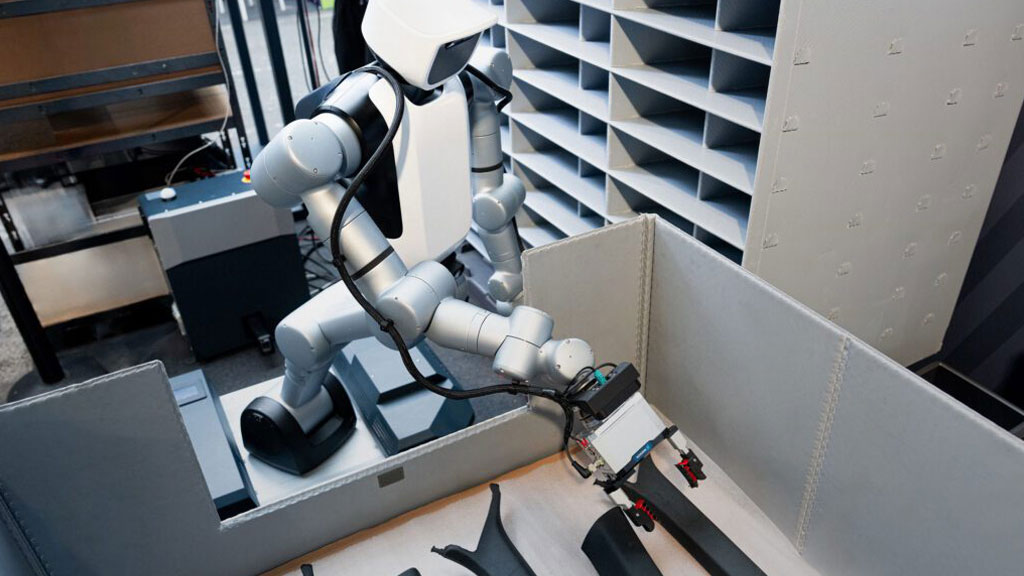
Audi Tests Humanoid Robots to Transform Factory Logistics
German automaker explores AI-powered humanoid robots to automate one of manufacturing’s most complex tasks without redesigning existing production facilities.
Audi is testing humanoid robots developed by Agile Robots as part of a pilot project aimed at improving parts sequencing and logistics at its Ingolstadt production facility in Germany.
The proof-of-concept project, unveiled at GTC Berlin, brings together Audi, Agile Robots, Nvidia and Dassault Systèmes in an effort to tackle one of the automotive industry’s longest-standing automation challenges.
The robots are currently being tested in Audi’s Production Lab, where supply chain and logistics teams are assessing their ability to handle complex picking and sequencing tasks before potential wider deployment.
Tackling a Major Manufacturing Challenge
Parts sequencing plays a critical role in vehicle production.
Every day, Audi’s logistics operations involve approximately one million picking processes to ensure the correct components arrive at assembly stations in the required order.
Many of these tasks remain difficult to automate because components often vary in shape, size and packaging. Semi-rigid parts and items stored in unsorted bins have traditionally required human intervention.
Agile Robots’ humanoid systems use advanced artificial intelligence and machine vision to identify, pick and organize components, allowing them to handle tasks that conventional industrial robots often struggle to perform.
Humanoid Design Offers Flexibility
Unlike fixed industrial robots that often require purpose-built workspaces, the Agile Robots units are mounted on mobile platforms and designed to operate at human working height.
This allows them to move through existing logistics environments without requiring major infrastructure modifications.
For manufacturers such as Audi, this flexibility could reduce implementation costs and simplify automation projects by allowing robots to integrate into current workflows.
The approach could prove attractive for factories looking to increase automation without extensive redesigns of production facilities.
Digital Twin Technology Reduces Risk
Before any physical deployment, Audi uses advanced simulation technology to evaluate the robots’ performance in a virtual environment.
A digital twin of the logistics area has been created using Dassault Systèmes’ Delmia platform and Nvidia Omniverse technology.
The simulations allow engineers to test feasibility, safety, productivity, ergonomics and timing before introducing robots into real-world operations.
According to the project partners, future AI-powered assistants could dramatically accelerate this planning process, reducing simulation and deployment preparation from months to just days.
More Than 20,000 Robots Already Installed
Munich-based Agile Robots is an established robotics company with more than 20,000 robotic systems deployed globally.
The company’s humanoid robots are viewed as a new step in industrial automation, combining mobility, artificial intelligence and human-like movement capabilities.
If the pilot proves successful, the technology could pave the way for broader adoption across Audi’s production network and potentially throughout the wider automotive industry.
AI Driving the Future of Manufacturing
Audi believes artificial intelligence will play a central role in shaping the future of vehicle production.
Gerd Walker, Audi’s Board Member for Production and Logistics, said the company views the combination of industrial expertise and AI as critical to improving productivity.
He noted that parts picking and sequencing has remained one of the toughest automation challenges in automotive logistics for decades and that AI-powered robotics could help unlock substantial efficiency gains.
As manufacturers around the world seek smarter and more flexible production methods, projects such as Audi’s humanoid robot trial offer a glimpse into how factories of the future may operate.